
The University of Lille is maintaining its active participation in NeurotechEU, the European University of Brain and Technology for the second phase of the project (2023-2027). This new phase aims to strengthen collaboration between education, research and innovation through a consortium of some of Europe's leading universities.
This phase involves the entire university community: students, professors, researchers, administrative and academic staff. Combining mobility, scientific cooperation and technological innovation, this initiative is designed to make NeurotechEU an integrated ecosystem that will shape tomorrow's solutions in brain sciences and related technologies.
Governance and operations
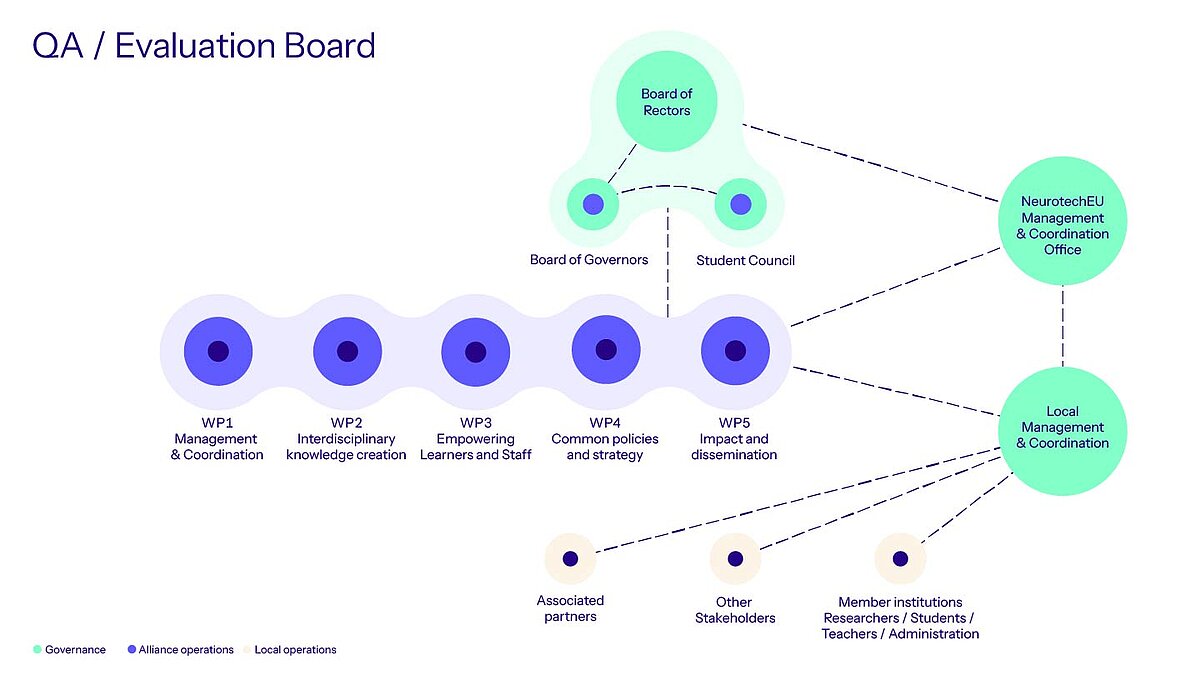
NeurotechEU's governance structure is based on three main areas: strategic, alliance-wide operational and direct local operations. This approach ensures effective coordination between partners and coherent implementation of actions.
Work Packages are at the heart of this structure. Each is led by a member university, with co-leads to ensure a collaborative approach. They translate the alliance's strategic objectives into concrete actions in the key areas of education, research, innovation, inclusion and sustainability.
Work Packages : building cooperation and innovation in NeurotechEU
NeurotechEU, is built around a number of Work Packages (WP) designed to integrate education, research and innovation. These Work Packages play a key role in strengthening cooperation between the partner universities and structuring a cutting-edge European neurotechnology ecosystem.
A flexible approach for an inclusive European university
In this new phase the Work Packages are build around :
- improving the management and the coordination of the project (WP1),
- the development of interdisciplinary knowledge and innovative training (WP2),
- engagement and mobility of students and academic staff (WP3),
- the development of common strategies and policies to ensure the sustainability of the alliance (WP4),
- impact assessment and dissemination of NeurotechEU's achievments (WP5).
With this structure, NeurotechEU is consolidating its ambition to create a European campus for brain sciences and technologies, facilitating international mobility and collaboration, positioning Europe as a leader in the field.
Led by Radboud Universiteit (the Netherlands) and co-led by Universidad Miguel Hernández de Elche (Spain), this WP aims to optimise the governance of the alliance by establishing a modular and scalable structure suited for international, inter-institutional, and cross-sector collaboration. It ensures alignment of activities with NeurotechEU values, oversees financial and budgetary management in accordance with regulations, strengthens internal communication, and reduces risk through a proactive management strategy.
Deliverables are concrete productions (reports, digital platforms, training modules, events, evaluation tools, etc.) corresponding to the key stages of the project. Approved before submission to the European Commission, they meet the requirements of the Erasmus+ 2021-2027 programme.
Those of WP1 illustrate the implementation of governance, internal communication and a quality system to ensure the sustainability of the alliance.
- Deliverable 1.1: Governance structures and management including internal communication.
- Overview of governance structures and management processes, including channels and procedures for effective internal communication within the alliance.
- Deliverable 1.2: Quality guidelines and mechanisms for implementation.
- A comprehensive set of quality guidelines and mechanisms ensuring the implementation of high standards across deliverables and activities.
The University of Lille's representatives
Dany Lefort
Communication Officer for European projects

With a Masters in Influence and Reputation and a specialisation in political and public communication, my experience has led me to work on influence strategies, reputation management and the dissemination of information to a variety of audiences.
Within NeurotechEU, I contribute to promoting and developping the project. I contribute to the visibility, dissemination and strategic communication of NeurotechEU at both local and international levels. I co-lead the Work Group Communication under Work Package 5 “Impact and Dissemination” where I take part in the dissemination and stakeholder engagement strategy, as well as the Work Package 1"Management and Coordination" where I work alongside my colleagues to ensure the coherence and effectiveness of the actions implemented at consortium level.
At the national level, I participate in the network of communicators from French universities involved in European alliances (GT-UEFR), contributing to collective reflection on communication strategies for EU-funded initiatives. My main goal is to strengthen internal and external communication in order to raise NeurotechEU's visibility among different audiences.
Jutta Escher-Kolski
Internationalisation Officer
As NeurotechEU Project Manager for the University of Lille my responsabilities are to identify, implement and monitor integrative projects with a European and international dimension: Europeanisation and sustainable internationalisation of training, exchanges, research-based programmes, actions covered by Erasmus+ and other European, binational or international programmes.
Since 2022, my contribution to NeurotechEU has been to represent ULille in the Work Package 1 “Management and Coordination”:management and coordination, finance, reporting, internal communication, monitoring and quality management. I am also keen to support the Work Package 5 “Impact and Dissemination” on measuring the impact of NeurotechEU.
In France, I'm part of the network that brings together French project Managers from different European university alliances (GT-UEFR).
Valentin Thanh Hai Dauphin
Financial officer for european projects
As the person in charge of financial management and expense monitoring, I assist the project coordinator with financial reporting to the European Commission.
Within NeurotechEU, I am involved in the Work Package 1 “Management and Coordination”.
Led by Radboud Universiteit (Netherlands), co-led by Karolinska Institutet (Sweden) and Rheinische Friedrich-Wilhelms-Universität Bonn (Germany), This Work Package focuses on developing a holistic and inclusive curriculum aligned with the 8 dimensions of neurotechnologies. It aims to create inter-institutional Master's and PhD programmes, enhance the Campus+ learning platform, and develop innovative educational tools and immersive learning experiences supported by AI.
Deliverables are concrete productions (reports, digital platforms, training modules, events, evaluation tools, etc.) corresponding to the key stages of the project. Approved before submission to the European Commission, they meet the requirements of the Erasmus+ 2021-2027 programme.
The WP2 deliverables aim to strengthen the overall accessibility and outreach of training in brain sciences and technology, ensuring alignment with the diverse needs of learners.
- Deliverable 2.1 : Scientific challenges in neurotechnology.
- An English-language digital report defining scientific challenges based on the 8 dimensions of neurotechnology, considering innovation, sustainability and societal impact.
- Deliverable 2.2 : Learning goals and joint education programmes.
- Definition of learning objectives and development of joint education programmes in neurotechnology.
- Deliverable 2.3 : Establish an overarching online student platform following Erasmus Without Papers standards :
- Development of an integrated online education platform.
- Deliverable 2.4 : Develop inclusive and flexible pedagogical methods for learners at all levels :
- Creation of flexible learning pathways led by the University of Lille.
- Creation of flexible learning pathways led by the University of Lille.
The University of Lille's representatives
Jean-françois Bodart
Vice-President of Internationalisation of Study Programmes

University Professor of Cell Biology and Developmental Biology, Vice-Dean for International Relations at the Faculty of Science and Technology (2017-2022), Vice- President for Pedagogical Innovations (2022-2025), Vice-President of Internationalisation of Study Programmes (2025-present day). Within the project, I am coordinating the Work Package 3 "Empowering Learners and Staff" and I am also involved in the Work Package 2 “Interdisciplinary Knowledge Creation”, regarding the coordination and writing of the Innovative Pedagogy handbook.
Renaud Jardri
University professor and medical practitioner

Professor of Psychiatry for Children and Adolescents (UFR3S at the University of Lille and Lille University Hospital), INSERM team leader at the Lille Neuroscience and Cognition Centre (Beliefs and Perception team), director of the Brain, Technologies and Society graduate programme at the University of Lille.
My research is mainly centred around the understanding, assessment and management of hallucinatory experiences and delusional beliefs, using methods derived from cognitive science, functional brain imaging, neuromodulation and computational modulation.
Within NeurotechEU, I am involved in the Work Package 2 “Interdisciplinary Knowledge Creation” as referent for the European Master of Neurotechnology for the University of Lille.
Co-led by Universitatea de Medicină și Farmacie din Cluj-Napoca (Romania) and the University of Lille, this WP integrates the values of inclusion and diversity into all training and research programmes. It provides tools to enhance mobility and learning opportunities, offers online training on equal opportunity, and supports entrepreneurship and innovation.
Deliverables are concrete productions (reports, digital platforms, training modules, events, evaluation tools, etc.) corresponding to the key stages of the project. Approved before submission to the European Commission, they meet the requirements of the Erasmus+ 2021-2027 programme.
The deliverables of WP3 aim to strengthen the participation of both students and staff in the training and mobility programmes, while integrating NeurotechEU's cethical values.
- Deliverable 3.1 : Alliance-wide platform for grants and tenders :
- A platform allowing students and staff to access mobility funding opportunities.
- Deliverable 3.2 : Online training and support :
- Development of accessible online training modules on equal opportunity for all partners.
- Deliverable 3.3 : Charter of NeurotechEU++ values : Guidelines for practitioners including a pathways for social impact
- A values charter and ethical practice guidelines.
- Deliverable 3.4 : Blueprint for new training formats in innovation and entrepreneurship
- Training programmes including internships within partner organisations.
- Training programmes including internships within partner organisations.
The University of Lille's representatives
Caroline Pouettre
International mobility Officer
After obtaining a Master's degree in European project management and learning about international cooperation at the Vrije Universiteit in Amsterdam, I am now in charge of international mobility at the University of Lille, and more specifically NeurotechEU mobility for staff and students.
Within NeurotechEU, I am part of the Work Package 3 “Empowering learners and Staff” dedicated to mobility and opportunities for training, courses, conferences and other events at partner universities.
Diogo Pereira Almanacy
Coordination officer of MoveOn
Within NeurotechEU I am involved in the “WP3 Empowering Learners and Staff”.
Mounia Boukhoums
Director of International Mobility
As Director of International Mobility, I joined the NeurotechEU alliance on the international mobility side at the same time as I started my new position.
My involvement in the “WP3 Empowering learners and Staff” working group is also a way for me to work with the other partner universities in the alliance on a real strategy for mobility in the neurosciences, facilitating other types of mobility, such as intensive hybrid programmes and virtual mobility in the disciplinary fields surrounding neuroscience.
Led by Boğaziçi Üniversitesi (Turkey) and co-led by Universitatea de Medicină și Farmacie din Cluj-Napoca (Romania), WP4 develops shared policies and fosters long-term partnerships with new universities and European alliances. It explores pathways for sustainable development and promotes technology transfer strategies to ensure real-world application of neurotechnology innovations for the benefit of society and the EU economy.
Deliverables are concrete productions (reports, digital platforms, training modules, events, evaluation tools, etc.) corresponding to the key stages of the project. Approved before submission to the European Commission, they meet the requirements of the Erasmus+ 2021-2027 programme.
The deliverables of WP4 are intended to strengthen cooperation and develop concrete strategies for the long-term sustainability of NeurotechEU.
- Deliverable 4.1 : NeurotechEU report integrating multicultural components during events
- Best practices and inclusive approaches for promoting cultural diversity
- Deliverable 4.2 : Cooperation models including the sustainable regional development :
- Report identifying mechanisms to strengthen links between universities, regions, and stakeholders.
- Deliverable 4.3 : Translation of innovations into the industry :
- Strategy and recommendations for industrial adoption of neurotech innovations.
The University of Lille's representatives
Hakim Si-Mohammed
Associate Professor

Associate Professor specializing in neurotechnologies, virtual and augmented reality, brain-computer interfaces, and computer science, I am involved in the “WP4 Common policies and strategy development”.
Co-led by Karolinska Institutet (Sweden) and Radboud Universiteit (Netherlands),WP5 focuses on ensuring the visibility and relevance of NeurotechEU outcomes. It develops communication and dissemination strategies to promote best practices and results, while tracking progress using key performance indicators.
Deliverables are concrete productions (reports, digital platforms, training modules, events, evaluation tools, etc.) corresponding to the key stages of the project. Approved before submission to the European Commission, they meet the requirements of the Erasmus+ 2021-2027 programme.
The deliverables of WP5 are intended to strengthen NeurotechEU's impact at European level, by promoting collaboration with development organisations and innovative companies.
- Deliverable 5.1 : Comprehensive communication and dissemination strategy :
- A comprehensive plan identifying goals, audiences, tools, and channels. Includes event organisation, such as the Brain and Technology Museum, to anchor the alliance within the European Education and Research Area.
- Deliverable 5.2 : Roadmap report on achievments and impact indicators.
- Overview of NeurotechEU results: joint programmes, research centres, tech transfer, funding platforms, transnational campus framework, and updated action plan (NeurotechEU2040).
- Deliverable 5.3 : Strategy to build on the European Innovation Council Regional Innovation Ecosystem Initiatives :
- Recommendations to stimulate stakeholder collaboration, support innovation, and integrate NeurotechEU into local and European development ecosystems.
- Recommendations to stimulate stakeholder collaboration, support innovation, and integrate NeurotechEU into local and European development ecosystems.
The University of Lille's representatives
Arelis Ardiles
Communication officer for International Relations

After obtaining a master's degree in journalism in the public and private sectors, at the University of Lille, I began my career in the international relations office as part of my internships. I got my first contract when I was still an international student before the merger of the 3 university of Lille in 2018. Since 2017, I have been working as Communication officer for International relations.
My first work experience in the international development department was in 2018, as part of the first pilot call for the European Universities Initiative. I am now involved in European projects, in particular as a communications officer with the NeurotechEU Alliance, as part of the “WP5 Impact and Dissemination” working group.
Dany Lefort
Communication Officer for European projects
With a Masters in Influence and Reputation and a specialisation in political and public communication, my experience has led me to work on influence strategies, reputation management and the dissemination of information to a variety of audiences.
Within NeurotechEU, I contribute to promoting and developping the project. I contribute to the visibility, dissemination and strategic communication of NeurotechEU at both local and international levels. I co-lead the Work Group Communication under Work Package 5 “Impact and Dissemination” where I take part in the dissemination and stakeholder engagement strategy, as well as the Work Package 1"Management and Coordination" where I work alongside my colleagues to ensure the coherence and effectiveness of the actions implemented at consortium level.
At the national level, I participate in the network of communicators from French universities involved in European alliances (GT-UEFR), contributing to collective reflection on communication strategies for EU-funded initiatives. My main goal is to strengthen internal and external communication in order to raise NeurotechEU's visibility among different audiences.
Jutta Escher-Kolski
Internationalisation Officer
As NeurotechEU Project Manager for the University of Lille my responsabilities are to identify, implement and monitor integrative projects with a European and international dimension: Europeanisation and sustainable internationalisation of training, exchanges, research-based programmes, actions covered by Erasmus+ and other European, binational or international programmes.
Since 2022, my contribution to NeurotechEU has been to represent ULille in the Work Package 1 “Management and Coordination”:management and coordination, finance, reporting, internal communication, monitoring and quality management. I am also keen to support the Work Package 5 “Impact and Dissemination” on measuring the impact of NeurotechEU.
In France, I'm part of the network that brings together French project Managers from different European university alliances (GT-UEFR).
Phase 2 (2023 - 2027) : Towards a Europe-wide University
Overcoming institutional, disciplinary and geographical differences to bring out the full potential of education, research, innovation and creativity on a European scale.
Phase 2 of NeurotechEU is part of a process of far-reaching transformation. Following on from the foundations laid in the first phase, this new stage aims to overcome the structural constraints that are still holding back mobility and integration. We are working towards the emergence of an integrated European University, interconnected by flexible structures, a common academic base and shared digital tools.
Strenghtening a common alliance-wide governance model
In an effort to cross administrative and structural borders between institutions, NeurotechEU aims to establish new methods of inter-institutional cooperation with a view to achieving full -scale functional integration.
- Development and approval of shared organisational models.
- Alignment of governance and management procedures.
- Cross-university coordination of support services and tools.
Promoting flexible and integrated mobility
The alliance aims to strengthen mobility opportunities through an integrated approach combining physical, virtual and hybrid formats, supported by interconnected digital platforms.
- Objective : 35 % of student mobility and 15 % of staff mobility by 2030.
- Integration of mobility into academic and career paths.
- Deployment of targeted initiatives to encourage the participation of all publics.
Developing European-valued joint programmes
With a focus on structuring a European education area in neurotechnology, NeurotechEU is committed to developing co-constructed master's and doctoral degrees, run jointly by the partner institutions.
- Development of transversal joint specialisations on all campuses.
- Alignment of curricula with key skills for tomorrow's European society.
Increasing the impact of research through collaborative innovation
NeurotechEU is building a virtual research centre to connect infrastructures, mutualise resources and strengthen synergies between research, education and innovation.
- Online research centre launched as a complement to Campus+.
- Facilitated access to distributed resources.
- Strengthened connections between research, innovation and education.
Local implementation and involvement of the University of Lille
The University of Lille is responsible for the local implementation of NeurotechEU by involving its governance entities, academic components and research units. The project's territorial anchoring is based on close coordination between the education, research, international relations and innovation departments, to ensure that actions are aligned with institutional strategies.
This approach is based on ongoing dialogue with all of the university's stakeholders:
- Students: increasing awareness of mobility opportunities, co-construction of European career paths, involvement in NeurotechEU events.
- Researchers and teachers: participation in joint research and teaching programmes, access to a network of European infrastructures and an international scientific network.
- Administrative staff: support for mobility opportunities, management of cross-disciplinary activities, logistical coordination and local project communication.
Through its commitment to the alliance, the University of Lille is strengthening its position as a major contributor to European advances in neuroscience and neurotechnology.

NeurotechEU : Co-funded by the European Union. Views and opinions expressed are however those of the authors only and do not necessarily reflect those of the European Union or the European Education and Culture Executive Agency (EACEA). Neither the European Union nor the granting authority can be held responsible for them.
France2030 This work benefited from French government funding managed by the Agence Nationale de la Recherche under the France 2030 programme, under the reference ‘ANR-23-GURE-0011’.